



Ace-ex Project
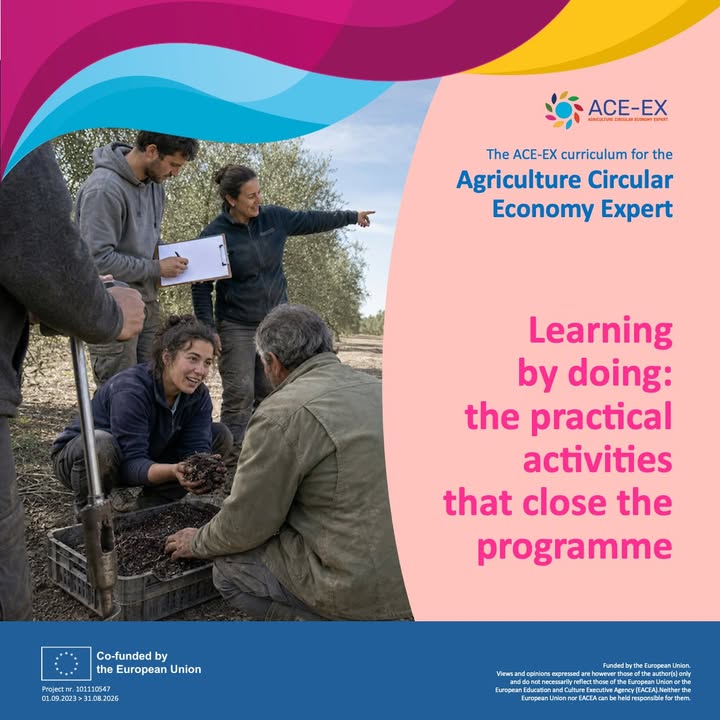
A training programme on the circular economy cannot end with a written exam. It must end with hands dirty — with soil, data, projects. The CE Principles: Development of Practical Activities course closes the ACE-EX programme in exactly this way: with field exercises, operational simulations and circular solution design for real contexts. 🛠️
Students do not remain in the classroom. They work on concrete cases from the wine, olive oil and cereals supply chains: designing waste reduction systems, calculating the economic feasibility of a biogas plant, identifying partners for industrial symbiosis, developing by-product valorisation plans. Every exercise integrates the competences acquired in the previous pillars — circular economy, innovation, organisational management, technical skills. 🧩
The course also connects to European initiatives for circular cities and regions, including the Circular City Centre created by the European Investment Bank, which supports circular projects at territorial level. 🏛️
This is the moment when theory from the four pillars becomes professional competence.
The moment when the student becomes the circular economy expert that ACE-EX sets out to train.
🔗 Link in bio
#ACEEX #LearningByDoing #CircularEconomy #Agriculture #ErasmusPlus #PracticalTraining #EUproject
🇪🇺 Co-funded by the European Union
ITS Academy Giulio Natta
CEP- Center for European Projects
OpenCom Italy
Sostenibilidad Cámara Valencia
AINIA Consumer
Softcare Studios
Střední průmyslová škola chemická a gymnázium Brno
Patrimonio Natural
Fagskolen Innlandet
Klaster Gospodarki Cyrkularnej i Recyklingu
Ies Federico García Lorca De la Puebla de Cazalla
Επιμελητήριο Φθιώτιδας
Confagricoltura
Ace-ex Project
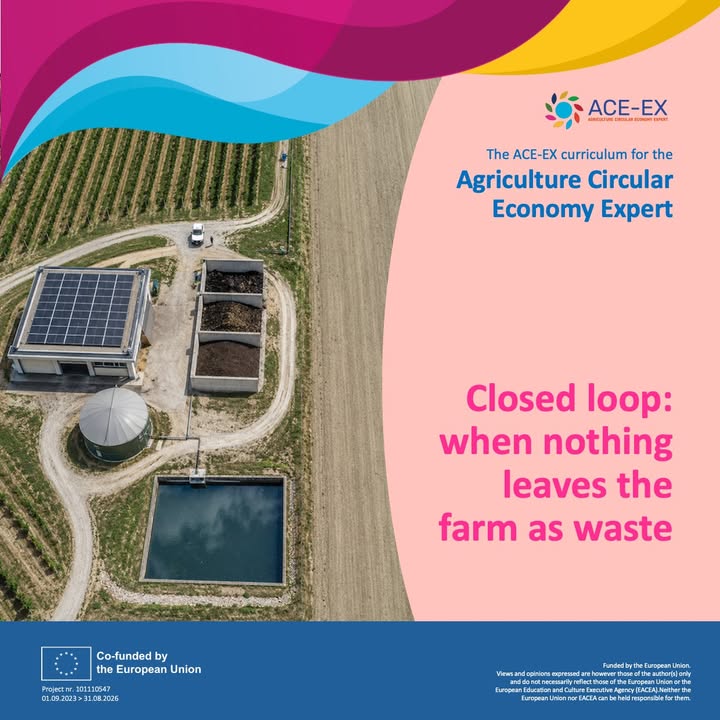
Imagine a winery where grape pomace becomes biogas to power the cellar, digestate fertilises the vineyard, process water is treated and reused for irrigation, grape seeds are sold for oil and polyphenol extraction. Nothing is lost. Everything returns. This is a closed-loop system. 🔄
The ACE-EX Technology and Resource Recovery in Agriculture course devotes specific modules to this approach: closed-loop farming systems and Product-as-a-Service (PaaS) models applied to agriculture. This is not merely about recycling — it is about redesigning the entire production model so that every output becomes the input of another process. 🏭
The closed-loop systems module addresses the design of integrated water-soil-energy-nutrient cycles. The PaaS module explores circular business models in which value lies not in product ownership but in the service it provides — with case studies from European farms that have already adopted these models. 📊
A further module looks ahead: emerging trends in agricultural circularity, European policies and innovation opportunities.
Designing systems where waste does not exist.
🔗 Link in bio
#ACEEX #ClosedLoop #CircularEconomy #Agriculture #ErasmusPlus #ResourceRecovery #ZeroWaste #EUproject
🇪🇺 Co-funded by the European Union
ITS Academy Giulio Natta
CEP- Center for European Projects
OpenCom Italy
Sostenibilidad Cámara Valencia
AINIA Consumer
Softcare Studios
Střední průmyslová škola chemická a gymnázium Brno
Patrimonio Natural
Fagskolen Innlandet
Klaster Gospodarki Cyrkularnej i Recyklingu
Ies Federico García Lorca De la Puebla de Cazalla
Επιμελητήριο Φθιώτιδας
Confagricoltura
Ace-ex Project
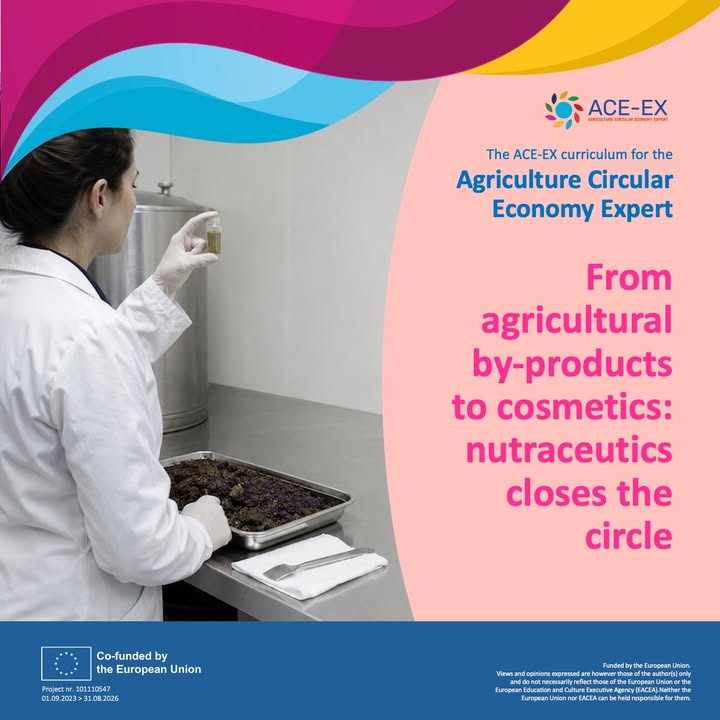
Grape polyphenols in anti-ageing creams. Grapeseed oil in facial serums. Olive squalene in moisturising formulas. Resveratrol in anti-ageing treatments. This is not marketing — it is applied biochemistry. And these molecules come from production waste. 💄
The ACE-EX Nutraceutics Applications in Cosmetics course is where circular agriculture meets the cosmetics industry. Starting from the composition of the skin, the causes of cellular ageing and oxidative stress, the course shows how by-products from the wine, olive oil and cereals supply chains contain precisely the molecules that the cosmetics industry seeks and pays dearly for. 🧴
The training covers: the structure and functions of skin layers, the mechanisms of free radical production, the antioxidant molecules present in agricultural by-products, and concrete cosmetic applications. An approach that turns the cost of waste disposal into the revenue of a premium ingredient. 🌿
Circular economy at its most advanced: from the vineyard to the cosmetics laboratory, from olive pomace to the bottle.
🔗 Link in bio
#ACEEX #Nutraceutics #Cosmetics #CircularEconomy #Agriculture #ErasmusPlus #GreenBeauty #Upcycling #EUproject
🇪🇺 Co-funded by the European Union
ITS Academy Giulio Natta
CEP- Center for European Projects
OpenCom Italy
Sostenibilidad Cámara Valencia
AINIA Consumer
Softcare Studios
Střední průmyslová škola chemická a gymnázium Brno
Patrimonio Natural
Fagskolen Innlandet
Klaster Gospodarki Cyrkularnej i Recyklingu
Ies Federico García Lorca De la Puebla de Cazalla
Επιμελητήριο Φθιώτιδας
Confagricoltura
Ace-ex Project
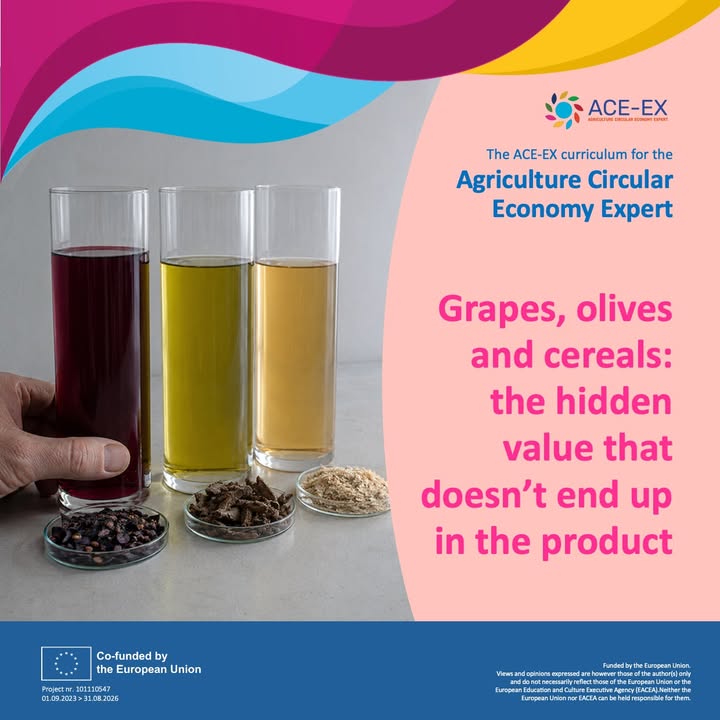
In wine production, only part of the grape becomes wine. The rest — skins, seeds, stems — contains polyphenols, resveratrol, anthocyanins. From olives pressed for oil, the remaining pomace is rich in squalene, oleic and linoleic acid. From cereals come selenium, zinc, vitamin E. Substances with antioxidant, anti-inflammatory and anti-ageing properties. 🍇
The ACE-EX Biochemistry course, developed by ITS Nuove Tecnologie della Vita, explores the biochemical composition of grapes, olives and cereals with a specific aim: helping sector professionals understand the potential of agricultural by-products as a source of high added-value compounds. 🔬
The course addresses the biochemical mechanisms of cellular ageing — oxidative stress, free radicals — and the natural molecules that counteract them: terpenes, vitamin A, vitamin C, vitamin E, squalene, fatty acids, polyphenols, resveratrol, anthocyanins, selenium, zinc. All present in the products and by-products of the three supply chains. 🧬
A course designed for farmers who want to maximise the value of their products, for commercial professionals in the nutraceutical sector and for chemists working in applied biochemistry.
🔗 Link in bio
#ACEEX #Biochemistry #Nutraceuticals #CircularEconomy #Agriculture #ErasmusPlus #Polyphenols #Resveratrol #EUproject
🇪🇺 Co-funded by the European Union
ITS Academy Giulio Natta
CEP- Center for European Projects
OpenCom Italy
Sostenibilidad Cámara Valencia
AINIA Consumer
Softcare Studios
Střední průmyslová škola chemická a gymnázium Brno
Patrimonio Natural
Fagskolen Innlandet
Klaster Gospodarki Cyrkularnej i Recyklingu
Ies Federico García Lorca De la Puebla de Cazalla
Επιμελητήριο Φθιώτιδας
Confagricoltura