



Ace-ex Project
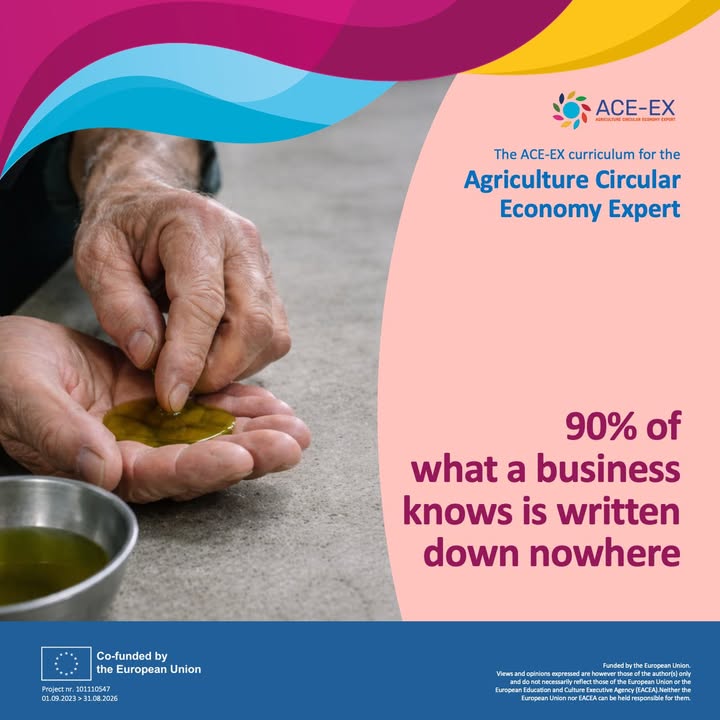
90% of what a business knows is written down nowhere
A farmer who recognises soil quality by touch. A miller who adjusts pressing temperature by ear. A winemaker who anticipates the right harvest moment by watching the sky. This is tacit knowledge: experience-based understanding impossible to find in any manual. In agricultural organisations, it accounts for roughly 90% of the knowledge base. 🧠
The problem? When that person retires or moves on, the knowledge leaves with them. The Open Management Style course, developed by OpenCom within ACE-EX, addresses this in its first module: how to identify, document and transform tacit knowledge into explicit organisational knowledge accessible to all. 📋
The tools range from structured expert interviews to field observation, process documentation to quality protocol coding. The reference model is Nonaka’s knowledge creation framework: socialisation, externalisation, combination, internalisation. A continuous cycle through which the organisation learns. 🔄
For agricultural businesses transitioning to a circular economy, this capability is strategic: new sustainable practices must integrate with traditional know-how, not replace it.
🔗 Link in bio
#ACEEX #KnowledgeManagement #OpenManagement #CircularEconomy #Agriculture #ErasmusPlus #TacitKnowledge #Euproject
🇪🇺 Co-funded by the European Union
Ace-ex Project
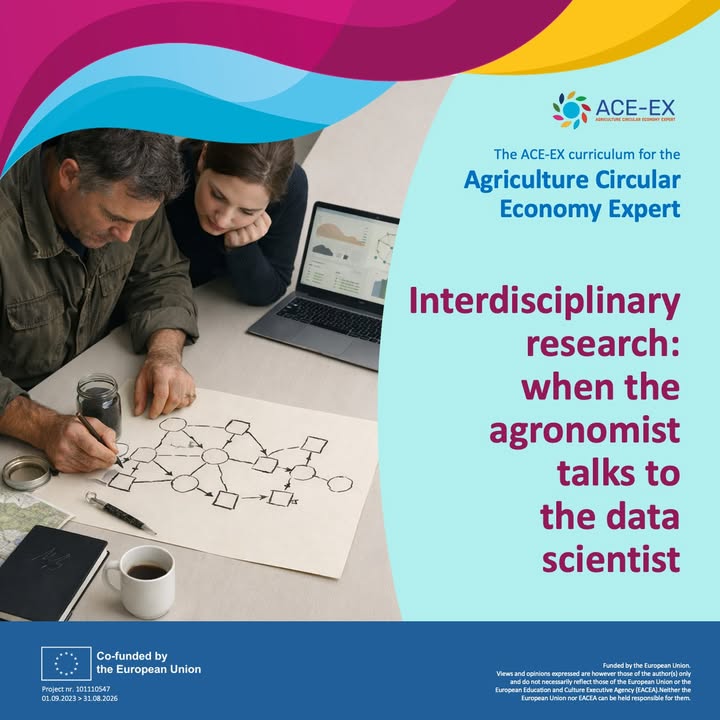
Interdisciplinary research: when the agronomist talks to the data scientist
A circular economy project in agriculture cannot be solved by a single area of expertise. It needs the agronomist who knows the soil, the engineer who designs the plants, the economist who analyses costs, the chemist who studies by-product valorisation, the data scientist who manages real-time information. 🧬
But making different disciplines work together is not straightforward. Different languages, different priorities, different methodologies. The interdisciplinary research module, within the ACE-EX Innovation Management course, addresses precisely this: how to build effective multidisciplinary teams, overcome communication barriers, align objectives and manage conflicts productively. 🤝
The tools proposed range from concept mapping to the Delphi method, agile project management to stakeholder mapping. The module also explores the role of data as a common language across disciplines and the ethical questions surrounding its use — from ownership to transparency, informed consent to bias mitigation. 📊
An important section concerns research scalability: how to move from a pilot project to large-scale application, through replication studies, adaptable models and open access to results. 🔬
Skills needed not only in academia, but wherever work happens at the intersection of different sectors.
🔗 Link in bio
#ACEEX #InterdisciplinaryResearch #Innovation #CircularEconomy #Agriculture #ErasmusPlus #Collaboration #Euproject
🇪🇺 Co-funded by the European Union
ITS Academy Giulio Natta
CEP- Center for European Projects
OpenCom Italy
Sostenibilidad Cámara Valencia
AINIA Consumer
Softcare Studios
Střední průmyslová škola chemická a gymnázium Brno
Patrimonio Natural
Fagskolen Innlandet
Klaster Gospodarki Cyrkularnej i Recyklingu
Ies Federico García Lorca De la Puebla de Cazalla
Επιμελητήριο Φθιώτιδας
Confagricoltura
Ace-ex Project
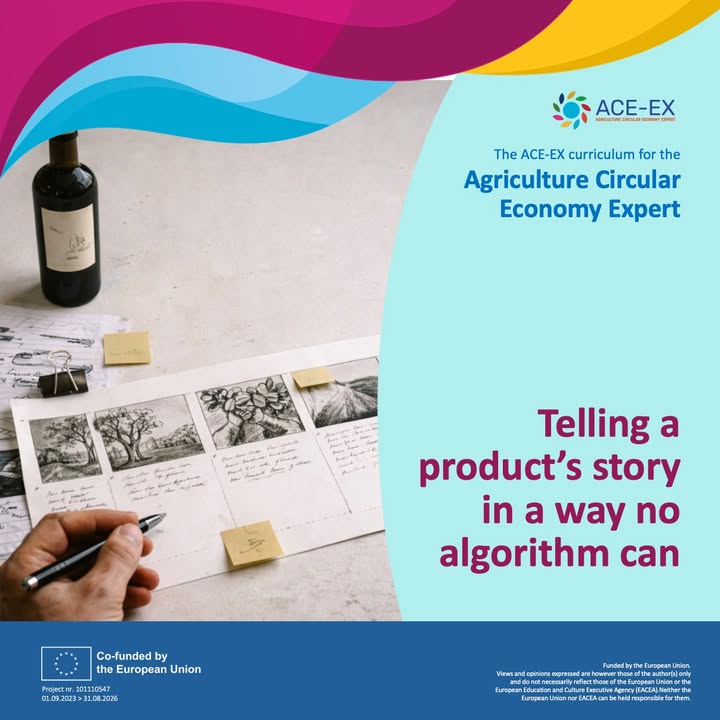
Telling a product’s story in a way no algorithm can
An organic fertiliser made from grape harvest residues. An extra virgin olive oil produced in a mill powered by its own waste. A rice grown in a zero-kilometre system where every by-product re-enters the cycle. These are products with a story. And that story is their first competitive advantage. 📖
Brand storytelling in agribusiness is not decoration. It is strategy. The ACE-EX Marketing & Communication course dedicates an entire module to building authentic narratives that connect values, practices and products. The aim is not to invent a story, but to communicate the real one effectively. 🎬
Techniques range from the “hero’s journey” structure, where the protagonist is the customer, not the brand, to user-generated content, agricultural influencer partnerships and content marketing built on real case studies. 🌾
The key point is consistency: if a business promotes circularity on its product packaging, that message must also be reflected on social media, at trade fairs, in emails and in relationships with distributors. A fragmented message is a weak message. A consistent one builds trust. ✅
The module is designed for rural entrepreneurs, producers and local developers who want to bring the value of their products to a wider audience.
🔗 Link in bio
#ACEEX #BrandStorytelling #ContentMarketing #Agriculture #CircularEconomy #ErasmusPlus #AgriMarketing #Euproject
🇪🇺 Co-funded by the European Union
ITS Academy Giulio Natta
CEP- Center for European Projects
OpenCom Italy
Sostenibilidad Cámara Valencia
AINIA Consumer
Softcare Studios
Střední průmyslová škola chemická a gymnázium Brno
Patrimonio Natural
Fagskolen Innlandet
Klaster Gospodarki Cyrkularnej i Recyklingu
Ies Federico García Lorca De la Puebla de Cazalla
Επιμελητήριο Φθιώτιδας
Confagricoltura
Ace-ex Project
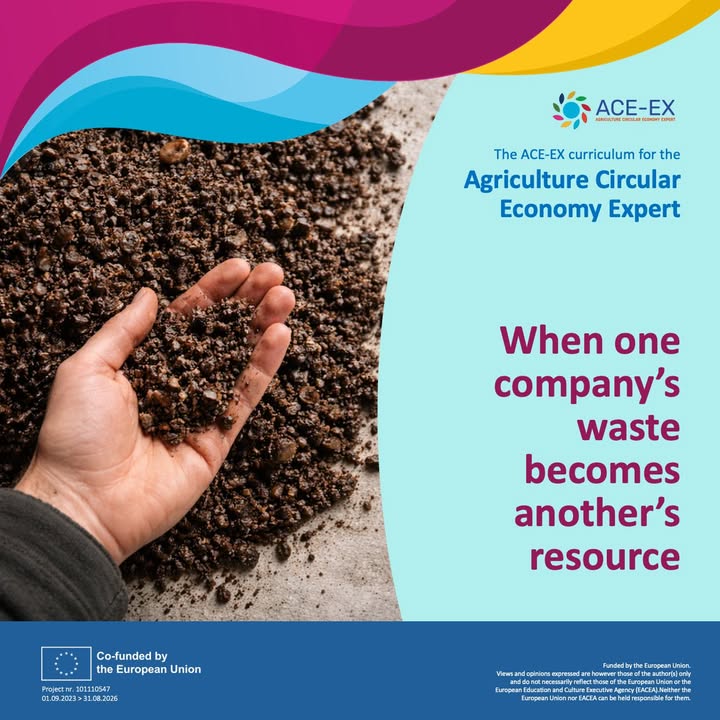
When one company’s waste becomes another’s resource
It is called industrial symbiosis and it is one of the most powerful concepts in the circular economy: one business’s by-products become raw material for another. Not in theory in the daily practice of real agricultural supply chains. 🔄
In Fiji, brewery residues feed mushroom cultivation, which in turn produces pig feed, whose waste enters anaerobic digesters generating nutrient-rich water for aquaculture. In Brazil, sugarcane bagasse is burned in cogeneration plants that supply electricity to the grid. In Italy, a cooperative of small dairy producers uses cheese whey as feed for local pig farms. 🌍
In Spain, within the olive oil sector, cooperatives have begun converting mill wastewater into biogas, generating new income streams whilst reducing environmental impact. In Greece, Kyklopas SA olive mill works with a biogas plant to manage its milling residues. 🫒
These are not exceptions. They are replicable models that the ACE-EX Business Model Adaptation course analyses in detail, providing tools to identify symbiosis opportunities within one’s own supply chain and build the necessary partnerships. 🤝
🔗 Link in bio
#ACEEX #IndustrialSymbiosis #CircularEconomy #Agriculture #WasteToResource #ErasmusPlus #Bioeconomy #Euproject
🇪🇺 Co-funded by the European Union
ITS Academy Giulio Natta
CEP- Center for European Projects
OpenCom Italy
Sostenibilidad Cámara Valencia
AINIA Consumer
Softcare Studios
Střední průmyslová škola chemická a gymnázium Brno
Patrimonio Natural
Fagskolen Innlandet
Klaster Gospodarki Cyrkularnej i Recyklingu
Ies Federico García Lorca De la Puebla de Cazalla
Επιμελητήριο Φθιώτιδας
Confagricoltura