



Ace-ex Project
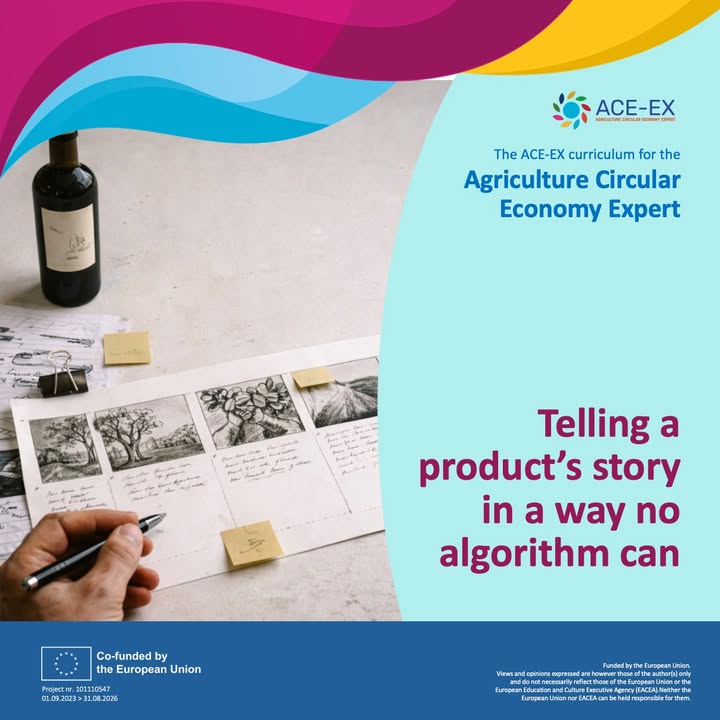
Telling a product’s story in a way no algorithm can
An organic fertiliser made from grape harvest residues. An extra virgin olive oil produced in a mill powered by its own waste. A rice grown in a zero-kilometre system where every by-product re-enters the cycle. These are products with a story. And that story is their first competitive advantage. 📖
Brand storytelling in agribusiness is not decoration. It is strategy. The ACE-EX Marketing & Communication course dedicates an entire module to building authentic narratives that connect values, practices and products. The aim is not to invent a story, but to communicate the real one effectively. 🎬
Techniques range from the “hero’s journey” structure, where the protagonist is the customer, not the brand, to user-generated content, agricultural influencer partnerships and content marketing built on real case studies. 🌾
The key point is consistency: if a business promotes circularity on its product packaging, that message must also be reflected on social media, at trade fairs, in emails and in relationships with distributors. A fragmented message is a weak message. A consistent one builds trust. ✅
The module is designed for rural entrepreneurs, producers and local developers who want to bring the value of their products to a wider audience.
🔗 Link in bio
#ACEEX #BrandStorytelling #ContentMarketing #Agriculture #CircularEconomy #ErasmusPlus #AgriMarketing #Euproject
🇪🇺 Co-funded by the European Union
ITS Academy Giulio Natta
CEP- Center for European Projects
OpenCom Italy
Sostenibilidad Cámara Valencia
AINIA Consumer
Softcare Studios
Střední průmyslová škola chemická a gymnázium Brno
Patrimonio Natural
Fagskolen Innlandet
Klaster Gospodarki Cyrkularnej i Recyklingu
Ies Federico García Lorca De la Puebla de Cazalla
Επιμελητήριο Φθιώτιδας
Confagricoltura
Ace-ex Project
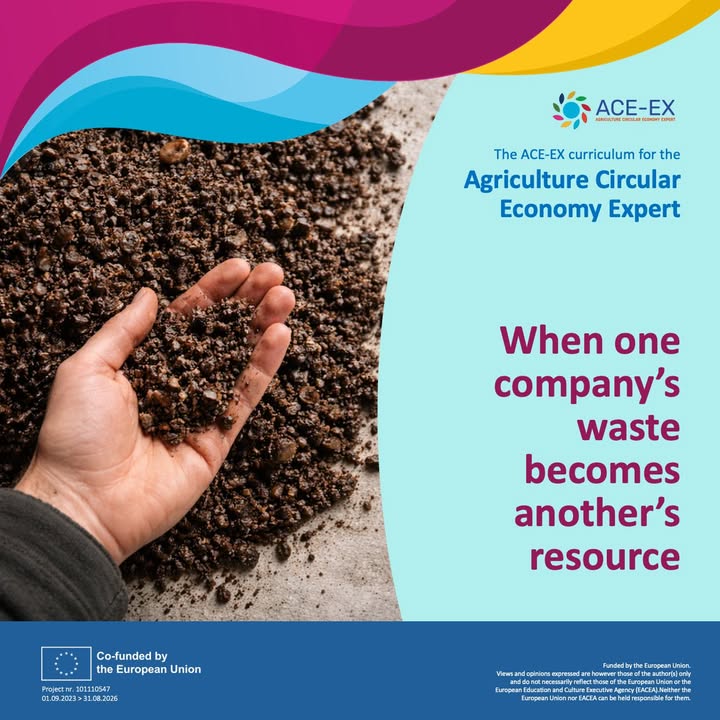
When one company’s waste becomes another’s resource
It is called industrial symbiosis and it is one of the most powerful concepts in the circular economy: one business’s by-products become raw material for another. Not in theory in the daily practice of real agricultural supply chains. 🔄
In Fiji, brewery residues feed mushroom cultivation, which in turn produces pig feed, whose waste enters anaerobic digesters generating nutrient-rich water for aquaculture. In Brazil, sugarcane bagasse is burned in cogeneration plants that supply electricity to the grid. In Italy, a cooperative of small dairy producers uses cheese whey as feed for local pig farms. 🌍
In Spain, within the olive oil sector, cooperatives have begun converting mill wastewater into biogas, generating new income streams whilst reducing environmental impact. In Greece, Kyklopas SA olive mill works with a biogas plant to manage its milling residues. 🫒
These are not exceptions. They are replicable models that the ACE-EX Business Model Adaptation course analyses in detail, providing tools to identify symbiosis opportunities within one’s own supply chain and build the necessary partnerships. 🤝
🔗 Link in bio
#ACEEX #IndustrialSymbiosis #CircularEconomy #Agriculture #WasteToResource #ErasmusPlus #Bioeconomy #Euproject
🇪🇺 Co-funded by the European Union
ITS Academy Giulio Natta
CEP- Center for European Projects
OpenCom Italy
Sostenibilidad Cámara Valencia
AINIA Consumer
Softcare Studios
Střední průmyslová škola chemická a gymnázium Brno
Patrimonio Natural
Fagskolen Innlandet
Klaster Gospodarki Cyrkularnej i Recyklingu
Ies Federico García Lorca De la Puebla de Cazalla
Επιμελητήριο Φθιώτιδας
Confagricoltura
Ace-ex Project
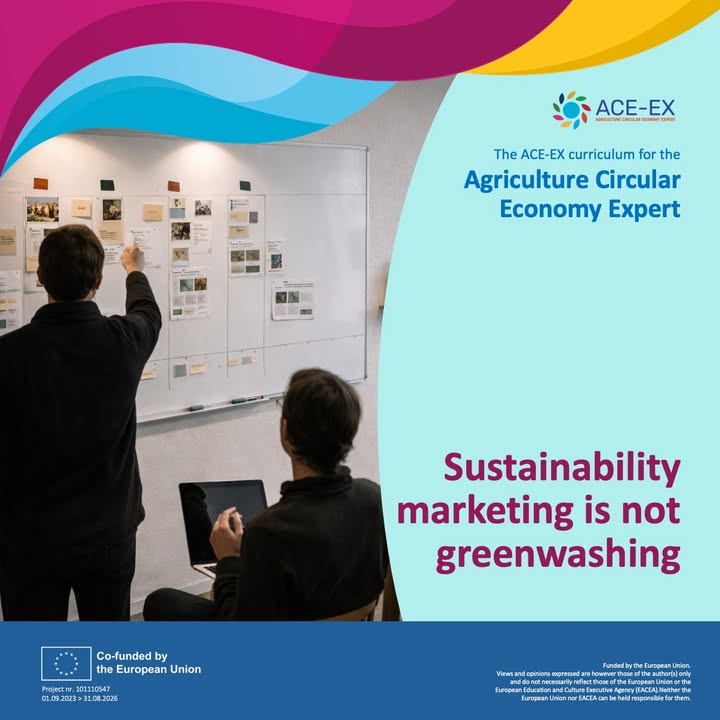
Sustainability marketing is not greenwashing
Communicating the sustainability of an agricultural product is very different from simply painting it green. Effective marketing within a circular economy context starts with understanding the market, segmenting the audience and building coherent, credible messages. 📣
The Marketing & Communication course developed by Kharkiv University within ACE-EX addresses this across five modules: from agri-marketing foundations to integrated communications, digital and social media marketing to consumer behaviour, through to brand storytelling. 30 hours of structured training. 📚
A key element? Integrated Marketing Communication (IMC), the ability to build a uniform, consistent message across every channel, from social media to trade fairs, product packaging to email campaigns. For an agricultural business that stakes its identity on circularity, the coherence between what it does and what it communicates is everything. 🎯
The course does not remain theoretical. It analyses real campaigns, from John Deere to Fairtrade International, Oatly to Patagonia Provisions, to show how brand storytelling can create authentic connections with farmers, businesses and consumers. 🌾
Because telling a true story is the finest marketing strategy there is.
🔗 Link in bio
#ACEEX #Marketing #Sustainability #AgriMarketing #CircularEconomy #ErasmusPlus #BrandStorytelling #Agriculture #Euproject
🇪🇺 Co-funded by the European Union
ITS Academy Giulio Natta
CEP- Center for European Projects
OpenCom Italy
Sostenibilidad Cámara Valencia
AINIA Consumer
Softcare Studios
Střední průmyslová škola chemická a gymnázium Brno
Patrimonio Natural
Fagskolen Innlandet
Klaster Gospodarki Cyrkularnej i Recyklingu
Ies Federico García Lorca De la Puebla de Cazalla
Επιμελητήριο Φθιώτιδας
Confagricoltura
Ace-ex Project
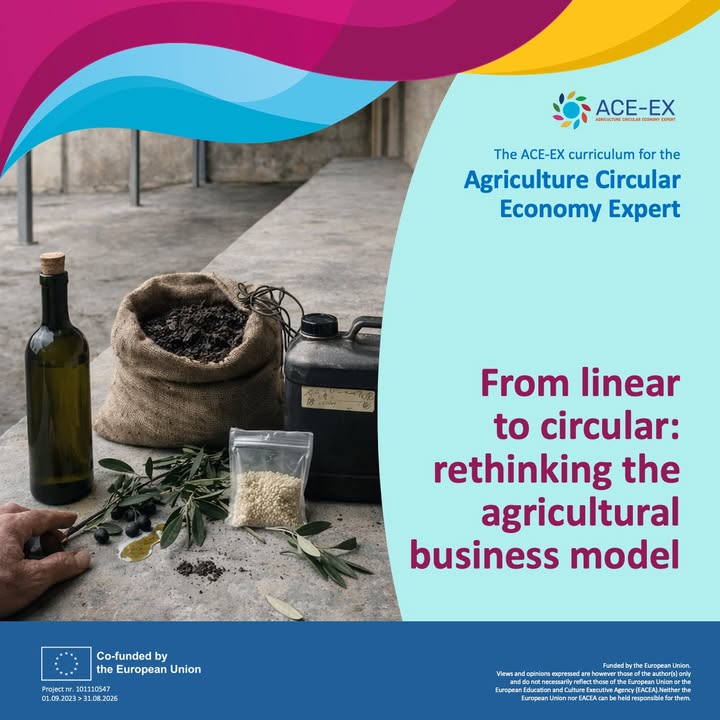
From linear to circular: rethinking the agricultural business model
An olive oil mill produces oil. It also produces pomace, vegetation water and pruning residues. In a linear model, these are waste to be disposed of. In a circular model, they are resources to be valorised: biomass for energy, substrate for biogas, raw material for biofertilisers or cosmetics. The difference is not only environmental it is economic. 🫒
The Business Model Adaptation course, developed by the Chamber of Commerce of Valencia, takes this observation as its starting point to explore how agricultural businesses can rethink their value chain. Seven modules covering the diagnosis of current models, transition strategies, implementation tools, new model design and the relevant regulatory framework. 📐
A key tool introduced in the course is the Circular Economy Canvas: a framework for analysing every stage of the product life cycle and identifying where to reduce waste, where to create value and where to activate synergies with other players in the supply chain. 📋
The case studies? From the Spanish olive oil industry, where cooperatives have converted mill wastewater into biogas. From the Montsià rice industry, which built a KM 0 circular economy model. From the wine sector, where pomace becomes animal feed or fertiliser. 🌱
24 hours of training for those looking to transform their business model.
🔗 Link in bio
#ACEEX #BusinessModel #CircularEconomy #Agriculture #OliveOil #Wine #ErasmusPlus #Innovation #Euproject
🇪🇺 Co-funded by the European Union
ITS Academy Giulio Natta
CEP- Center for European Projects
OpenCom Italy
Sostenibilidad Cámara Valencia
AINIA Consumer
Softcare Studios
Střední průmyslová škola chemická a gymnázium Brno
Patrimonio Natural
Fagskolen Innlandet
Klaster Gospodarki Cyrkularnej i Recyklingu
Ies Federico García Lorca De la Puebla de Cazalla
Επιμελητήριο Φθιώτιδας
Confagricoltura