



Ace-ex Project
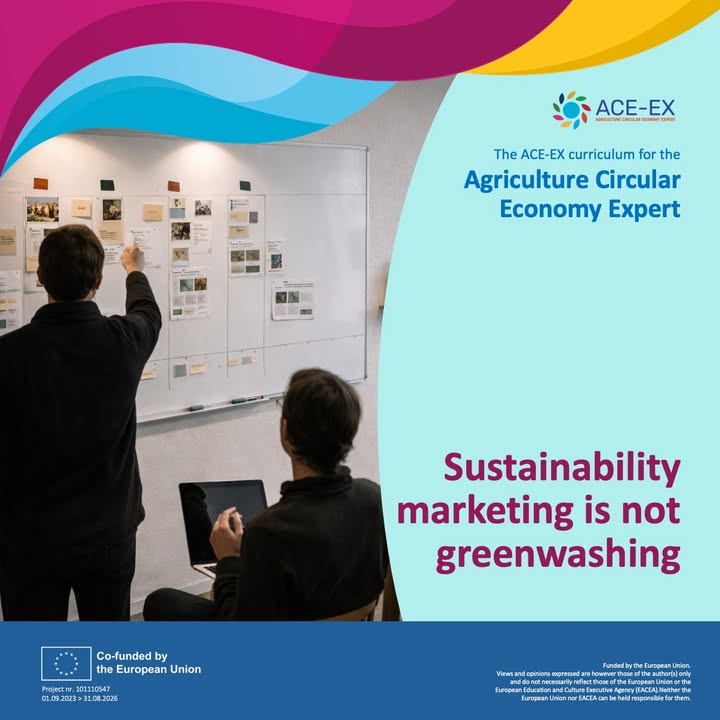
Sustainability marketing is not greenwashing
Communicating the sustainability of an agricultural product is very different from simply painting it green. Effective marketing within a circular economy context starts with understanding the market, segmenting the audience and building coherent, credible messages. 📣
The Marketing & Communication course developed by Kharkiv University within ACE-EX addresses this across five modules: from agri-marketing foundations to integrated communications, digital and social media marketing to consumer behaviour, through to brand storytelling. 30 hours of structured training. 📚
A key element? Integrated Marketing Communication (IMC), the ability to build a uniform, consistent message across every channel, from social media to trade fairs, product packaging to email campaigns. For an agricultural business that stakes its identity on circularity, the coherence between what it does and what it communicates is everything. 🎯
The course does not remain theoretical. It analyses real campaigns, from John Deere to Fairtrade International, Oatly to Patagonia Provisions, to show how brand storytelling can create authentic connections with farmers, businesses and consumers. 🌾
Because telling a true story is the finest marketing strategy there is.
🔗 Link in bio
#ACEEX #Marketing #Sustainability #AgriMarketing #CircularEconomy #ErasmusPlus #BrandStorytelling #Agriculture #Euproject
🇪🇺 Co-funded by the European Union
ITS Academy Giulio Natta
CEP- Center for European Projects
OpenCom Italy
Sostenibilidad Cámara Valencia
AINIA Consumer
Softcare Studios
Střední průmyslová škola chemická a gymnázium Brno
Patrimonio Natural
Fagskolen Innlandet
Klaster Gospodarki Cyrkularnej i Recyklingu
Ies Federico García Lorca De la Puebla de Cazalla
Επιμελητήριο Φθιώτιδας
Confagricoltura
Ace-ex Project
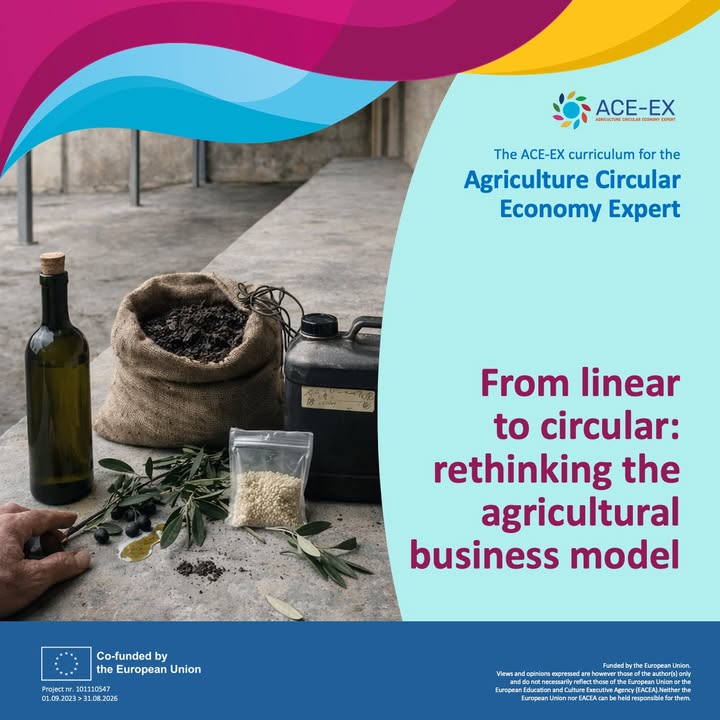
From linear to circular: rethinking the agricultural business model
An olive oil mill produces oil. It also produces pomace, vegetation water and pruning residues. In a linear model, these are waste to be disposed of. In a circular model, they are resources to be valorised: biomass for energy, substrate for biogas, raw material for biofertilisers or cosmetics. The difference is not only environmental it is economic. 🫒
The Business Model Adaptation course, developed by the Chamber of Commerce of Valencia, takes this observation as its starting point to explore how agricultural businesses can rethink their value chain. Seven modules covering the diagnosis of current models, transition strategies, implementation tools, new model design and the relevant regulatory framework. 📐
A key tool introduced in the course is the Circular Economy Canvas: a framework for analysing every stage of the product life cycle and identifying where to reduce waste, where to create value and where to activate synergies with other players in the supply chain. 📋
The case studies? From the Spanish olive oil industry, where cooperatives have converted mill wastewater into biogas. From the Montsià rice industry, which built a KM 0 circular economy model. From the wine sector, where pomace becomes animal feed or fertiliser. 🌱
24 hours of training for those looking to transform their business model.
🔗 Link in bio
#ACEEX #BusinessModel #CircularEconomy #Agriculture #OliveOil #Wine #ErasmusPlus #Innovation #Euproject
🇪🇺 Co-funded by the European Union
ITS Academy Giulio Natta
CEP- Center for European Projects
OpenCom Italy
Sostenibilidad Cámara Valencia
AINIA Consumer
Softcare Studios
Střední průmyslová škola chemická a gymnázium Brno
Patrimonio Natural
Fagskolen Innlandet
Klaster Gospodarki Cyrkularnej i Recyklingu
Ies Federico García Lorca De la Puebla de Cazalla
Επιμελητήριο Φθιώτιδας
Confagricoltura
Ace-ex Project
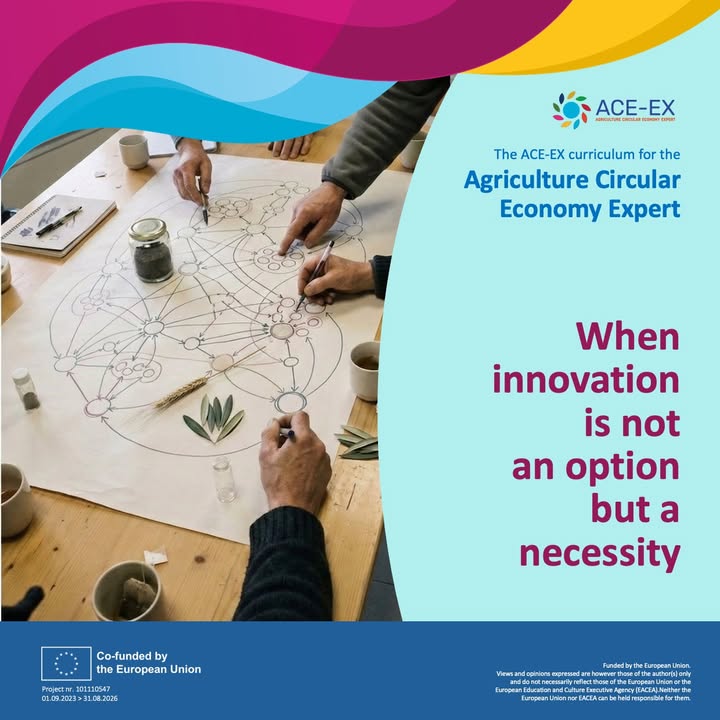
Managing innovation is not simply about adopting new technologies. It is about building a structured process to generate, evaluate and implement ideas in response to concrete challenges. In circular economy applied to agriculture, this capability is decisive. 💡
The Innovation Management course developed by Softcare Studios within ACE-EX covers six modules: from the foundations of innovation in a circular context to sustainable leadership, transversal skills to interdisciplinary research, digital transformation to complexity management. 📚
A central point? Systems thinking. In agriculture, soil, water, crops and energy cycles are deeply interconnected. Changing one element, the type of packaging, for instance, affects production, logistics and waste management. Innovating effectively requires the ability to see the entire system, not just one component. 🔄
The course also addresses barriers to innovation, financial constraints, organisational resistance to change, technological gaps and proposes practical tools to overcome them, from agile project management to stakeholder mapping. 🧩
24 hours of training for those who need to lead change processes, not merely endure them.
🔗 Link in bio
#ACEEX #Innovation #InnovationManagement #CircularEconomy #Agriculture #ErasmusPlus #SystemsThinking #EUproject
🇪🇺 Co-funded by the European Union
ITS Academy Giulio Natta
CEP- Center for European Projects
OpenCom Italy
Sostenibilidad Cámara Valencia
AINIA Consumer
Softcare Studios
Střední průmyslová škola chemická a gymnázium Brno
Patrimonio Natural
Fagskolen Innlandet
Klaster Gospodarki Cyrkularnej i Recyklingu
Ies Federico García Lorca De la Puebla de Cazalla
Επιμελητήριο Φθιώτιδας
Confagricoltura
Ace-ex Project
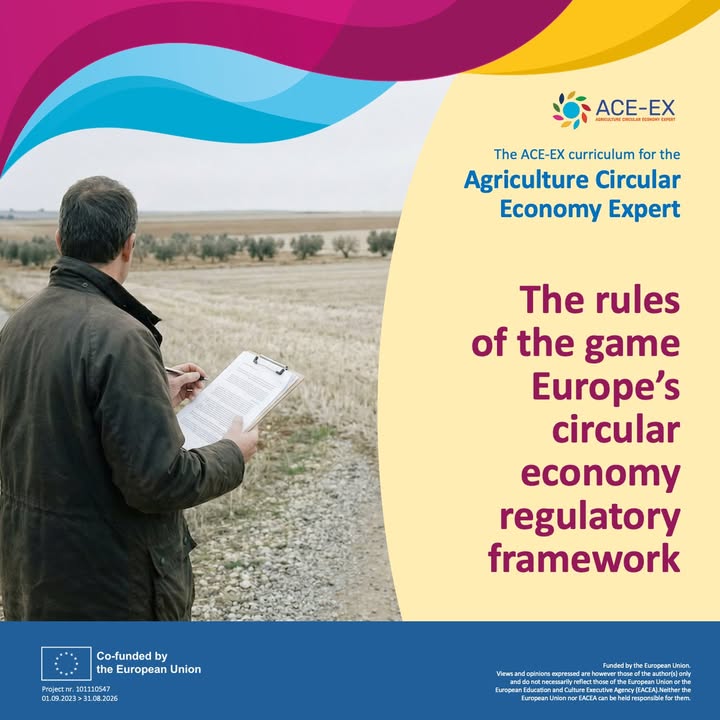
The rules of the game: Europe’s circular economy regulatory framework
Good circular practices do not emerge in a vacuum. Behind them lies a European regulatory framework that steers, incentivises and in some cases mandates them. For those working in the agricultural sector, understanding this framework is not optional. 📜
The starting point is the Circular Economy Action Plan (CEAP), adopted by the European Commission in 2020 as a pillar of the Green Deal. The plan covers the entire product life cycle: from ecodesign to durability, repairability to recycled content, through to tackling planned obsolescence. For the agri-food sector, the CEAP places specific focus on the food-water-nutrient chain. 🌍
Alongside the CEAP, the EU Bioeconomy Plan promotes the transformation of waste and residues into high-value products — animal feed, green chemicals, textiles — with the aim of reducing dependence on non-renewable resources. The Integrated Nutrient Management Plan targets the optimisation of fertiliser use and stimulation of recovered nutrient markets. 🧪
The Regulatory Framework course developed within ACE-EX by Fundación Patrimonio Natural de Castilla y León covers four areas: EU circular economy policies, available incentives, alignment with the Sustainable Development Goals, and skills for international cooperation. 📋
30 hours of training to navigate a regulatory landscape in constant evolution.
🔗 Link in bio
#ACEEX #CircularEconomy #EUPolicy #CEAP #GreenDeal #Agriculture #ErasmusPlus #RegulatoryFramework #EUproject
🇪🇺 Co-funded by the European Union
ITS Academy Giulio Natta
CEP- Center for European Projects
OpenCom Italy
Sostenibilidad Cámara Valencia
AINIA Consumer
Softcare Studios
Střední průmyslová škola chemická a gymnázium Brno
Patrimonio Natural
Fagskolen Innlandet
Klaster Gospodarki Cyrkularnej i Recyklingu
Ies Federico García Lorca De la Puebla de Cazalla
Επιμελητήριο Φθιώτιδας
Confagricoltura